


This thesis is a showcase on combining traditional, literary storytelling and architecture. Traditional being writing a book, and architecture being the pencil and paper. Many ideas go into crafting a narrative, this one in particular will use concepts from utopia, climate change, political papers, worldbuilding, and more. Here is a peek of what is below.
The year is 2407, humanity’s high heat producing industries have taken to the skies. Many people have moved with their work and are now living on Earth’s Haven Ring. On paper, Haven looks like a utopia, but in reality, it is an illusion. Many cities both on and off the surface live with rolling blackouts due to the energy needed to supply new technologies and people. Neighboring an abandoned mine on the planet’s surface, two families’ desire to separate themselves from the chaotic fast-paced outer world to create their own utopian oasis.
The Big Idea
Welcome to the story of August Heart. At the beginning of the year I told myself I should do something fun, since this will be the thing that takes over my life for the next nine months. I have always liked creating props a models from movies or my imagination that held their own little stories, but I have always wanted to do something bigger. I wanted to challenge myself to do something I haven’t done before, creating a world. I wondered what architecture could do if it were a pencil. And it was here where I landed on the question: How can architecture be the physical medium to crafting a narrative?
Architecture is typically thought of as a very practical real-world container for a certain task. To me that feels like a very close-minded point of view. What I want to bring forward is the idea that at its core, architecture can be defined as people creating a structure for others to interact with. If we look into the past we see that architecture once had the predominant role of creating an environment with a deeper meaning. Stories were baked into the very essence of the construction to emphasize certain meanings or lessons. This concept does not have to be constrained to the real world. We have books, films, and artwork everywhere in the world that uses architecture to convey their story’s themes. We see this most prominently in film sets. Every detail is meticulously designed with a purpose toward the narrative all the way from the many iterations of concept design to the final product that is shown on screen. I believe architecture is an art form itself. This project follows the process of constructing a narrative where architecture is the pencil and paper for writing a book.

Proof of Concept


Fragments
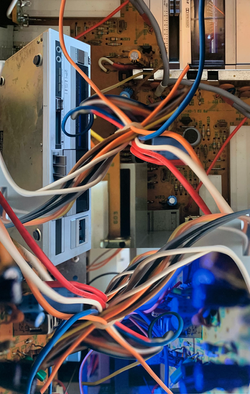
(Un)Worlding is a term by Jack Halberstam that means to take apart and reassemble differently. Fragments is a digital collage of parts from a cassette player reconstructed into a futuristic cityscape. The elements are both recognizable and foreign at the same time.


Ersilia
The barren landscape that is Ersilia came from a short story within the book, Invisible Cities by Italo Calvino. This drawing is an exercise using the term "moldy worldbuilding" to understand how it works in an illustrated medium rather than writing or film.

The Story

The orbital ring, or as it is called it in this future, The Haven Ring, is a sanctuary for industries and was created during the climate revitalization period. All of Humanities industrial facilities could be built entirely off the planet where they have a proper environment to expel all that unwanted waste energy into the cold vacuum of space. This would essentially stop excess heat from being added to the earth’s climate system almost entirely. With jobs moving off planet so too will the people. Even though Haven is a utopia for machines it is not one for people. The concept of utopia is an insincere veil clouding their perception of what life can be. Haven is a perfect enclosure to get sucked into a droning society. People work as cogs in a grand machine with little personality or knowledge of what they are missing. Up on the ring, life moves strictly in the fast lane, it feels sterile and two dimensional; there is very little to no time for making genuine connections with your neighbors. One could see today’s society being mimicked on the ring.

August Heart began as a settlement for workers during the Minnesota mining boom. Over the years the settlement grew into a full-blown town, and just like the town, the strip mines next door had grown into quarries and later on into Pollen fields. The majority of the area used to be covered by neighborhoods Workforce Housing Units (WHU), or the “Who” as the locals called them. Each unit was fitted with a kitchen, living room, and bathroom on the main level while the second floor was strictly living quarters for the four inhabitants.


As technology evolved on the Haven Ring so did the day-to-day lives of our miner’s. A new form of excavating was introduced to the Minnesota Iron Range, Pollen Pillars. As a way to help minimize expelling heat and other pollutants onto the environment, Pollen Pillars are meant to extract the entirety of the proposed mining zone and take it up to The Hive located on the Haven Ring. Because of this new system, WHU inhabitants began leaving the soft familiar ground of their home, to follow a job that has moved to the firm yet false ground of the ring. During this transition period, many Housing Units were torn down or left behind because of this mass exodus. Only a handful are still left standing thanks to the decedents of the original WHU inhabitants.

A majority of units were put up for sale during the miner exodus and only a couple dozen units were bought. These units quickly became homes to those permanent residents, and later on some families even began passing them down as heirlooms.
There is one particular homestead that we will be taking a closer look at. Two families live on this property, the Thundermans and the McCallums, and they have created something quite special with their family homes, something that could be described as a personal utopia.


This is the joint market for the Thundermans and the McCallums to sell their goods and services. The McCallums sell produce grown in the garden and the milk and cheese from their herd of cows. The Thundermans sell spare parts for all sorts of machines and offer repair services through their machine shop. People from all over the local area come to the market not just for the products but also for the sense of community gained from their neighbors.


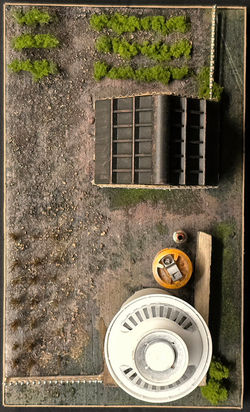
What started off as merely a small victory garden began to flourish into something much larger. Neighbors and other community members caught wind of fresh produce available, and the demand got so high that it was easier to open a permanent market with fixed hours rather than neighbors coming round at all hours of the day asking for zucchinis. Next to the shed there is a water silo, there are a few of these dotted around the farm for irrigating the crops, providing fresh water for the animals, and as a backup in the event of a drought.

The blue refurbished shipping container houses all the master controls for the various energy producers at the depot.
Across from the master controls sits four circular pools full of algae. As a byproduct of photosynthesis the algae produce hydrogen, which is stored in portable cannisters that are used as battery cells for vehicles, droids, and other machines.
In the river they have a hydro block, the kinetic energy is transferred through a cable to the generator behind the master controls, where power is then distributed to the rest of the homestead.
After a few generations of dwelling in these homes the two families have grown close, to the point of viewing each other as extended family. However, the Thundermans and the McCallums do not live in the same home, but they do live within the same house. Taking inspiration from a traditional function from longhouse, and wanting to preserve their family homes together, they have constructed a shell to protect their homes from the elements, and create a secondary interior dedicated to their professions. The inspiration that they took from the longhouse is a specific function during the wintertime where heat needs to be preserved. Animals and food are moved into the barn area of the house so the heat can be shared amongst everyone.

The Thundermans have utilized the newfound space as an extension of their machine shop for storage of spare parts. To them it is organized, but to the outside eye it looks like several piles of junk. As us artists know we need a lot of supplies at any given point.

The McCallums side is used for storing animal feed, farm supplies, and in the winter the cows call it home. It is neat and organized, everything has a purpose, place depending on the season.


A pile of train ticket stubs lay on a shelf in the Thunderman’s living room. Each ticket is from a trip they have taken to gather more parts for the shop.

Radios can be found within both homes as a form of pastime entertainment. A secondary purpose in having this type of radio is for communication with the surrounding township and county area.
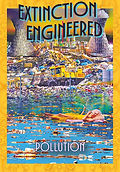


In the Mccallum’s home, Great-Grandpa’s old science magazines can be found in a drawer under the steps. The family keeps them around for sentimental reasons.
(Covers provided by Robert Angelo, Stevie Cade, Nick Palmer)

Collection
 |  |  |
|---|---|---|
 |  |  |
 |  |  |
 |  |  |
 |  |  |
 |  |  |
 |  |  |
 |  |  |
 |  |  |
 |  |  |
 |  |  |
 |  |  |
 |  |  |
 |  |  |